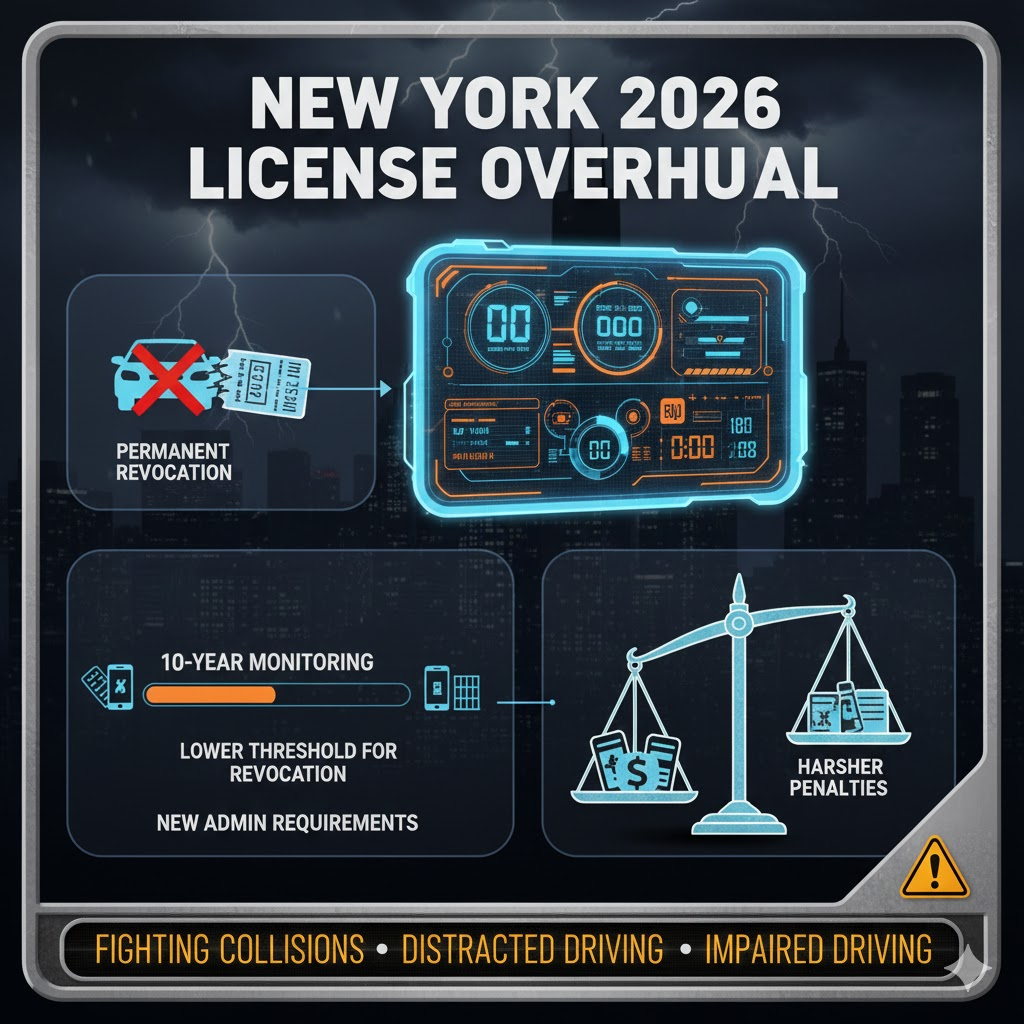
Albany, NY — New York State is preparing to enact one of the most comprehensive and far-reaching transformations to its driver’s license point system in decades. Beginning in 2026, drivers will face tougher penalties, a longer period of point tracking, new administrative requirements, and a lower threshold for permanent license revocation. The measures, according to transportation officials, are part of a broad statewide strategy to address rising collision rates, increased distracted driving, and persistent concerns regarding impaired driving.

The reforms signal a shift toward a more preventive, intervention-based system designed to flag high-risk drivers earlier and impose consequences more swiftly.
A Longer Look-Back Period Designed to Capture Patterns of Unsafe Driving
One of the most significant structural changes is the extension of the point “look-back period” from 18 to 24 months. This means that violations will remain active for two full years instead of a year and a half.
Officials argue that many drivers were previously avoiding corrective action simply because violations expired too quickly to reveal consistent risky behavior. Under the new system:
- Repeated speeding,
- Multiple cellphone violations, or
- A combination of high-risk actions
will be more likely to trigger suspensions, hearings, or mandated driver improvement programs.
Transportation analysts emphasize that the extended window will allow the DMV to build a clearer picture of a driver’s long-term behavior, rather than evaluate isolated incidents.
Increased Point Values Target High-Risk and Frequently Violated Offenses
New York’s decision to raise point values for several infractions reflects widespread concerns, especially in urban areas, over pedestrian injuries, construction worker safety, and school bus-related violations.
Under the 2026 system:
- Speeding in construction zones: 8 points (regardless of speed)
- Passing a stopped school bus: 8 points (up from 5)
- Handheld cellphone use: 6 points (up from 5)
- Failure to yield to pedestrians: 5 points (up from 3)
This marks one of the largest across-the-board increases in point values in years.
Safety advocates have long argued that the previous system failed to reflect the severity of these violations.
The reforms also introduce point assessments for violations that previously carried no point consequences, such as:
- Illegal U-turns: 2 points
Authorities believe assigning point values to these lower-level offenses will help reinforce safer driving in dense and high-traffic areas.
Dramatically Tougher Consequences for Alcohol- and Drug-Related Offenses
A cornerstone of the reform package is a more stringent approach to impaired driving.
The new system reduces the threshold for permanent license revocation:
- Drivers with four or more alcohol or drug-related convictions will be permanently barred from holding a New York license.
- Previously, this lifetime ban required five such convictions.
In addition:
- A single DWI conviction will now carry an 11-point penalty, placing offenders near or beyond the threshold for license suspension.
Transportation experts say this change could significantly shorten the time it takes to identify chronic impaired drivers who may pose a long-term risk to others on the road.
New Administrative Actions to Intervene Earlier and More Frequently
For the first time, New York will introduce graduated administrative actions based on point accumulation. These measures are aimed at identifying risky behavior before it escalates into suspension or revocation territory:
- 4–6 points: Drivers will receive an automatic warning letter notifying them that they are approaching a dangerous threshold.
- 7–10 points: Drivers may be required to attend a Driver Improvement Clinic, an educational and behavioral program intended to reduce recidivism.
- 9 or more speeding points within 24 months: Drivers will be mandated to attend a DMV hearing, allowing officials to determine whether enhanced penalties or restrictions should apply.
These interventions mark a move away from the previous “all-or-nothing” enforcement model, replacing it with a tiered system that emphasizes early corrective action.
Why These Changes Are Happening Now
State officials have cited several trends that helped shape the 2026 reform package:
- An increase in pedestrian collisions in urban corridors
- Higher rates of distracted driving, particularly related to cellphone use
- A noticeable rise in construction-zone injuries
- Repeated concerns about drunk and drug-impaired driving, especially among younger drivers
By raising point values and expanding the monitoring period, authorities hope to discourage repeat offenses and build a more accountable system.
Safety organizations across the state have cautiously welcomed the changes, although some groups argue that more education and public awareness campaigns will be necessary to inform drivers about the new rules.
Looking Ahead: What Drivers Should Expect
While the reforms do not take effect until 2026, state officials plan to launch public information campaigns to help drivers understand the upcoming changes.
Motorists may see:
- Updated materials at DMV offices
- Notices included with renewal documents
- Expanded warnings on the state’s traffic safety website
Insurance companies are also expected to update their policies and risk assessments based on the new point system, which could lead to higher premiums for drivers who accumulate points more quickly under the revised framework.

A Stricter System with Long-Term Road Safety Goals
With its 2026 overhaul, New York is positioning itself among the states with the toughest driving penalties in the U.S. The longer look-back period, higher point values, and emphasis on impairment-related offenses reflect a broader push to reduce fatalities, protect pedestrians, and hold habitual violators accountable.